
Enigma Rotor Machine
Published 17 Sep 2026 · · 11 min read
Enigma is the cipher that looks unbeatable on paper and lost a war in practice. Its key space was in the hundred-sextillions and it was broken not by brute force but by noticing that the machine could never encrypt a letter as itself — and that this one fact eliminated almost every wrong key instantly.
- Era
- Modern
- Type
- Polyalphabetic
- Key space
- 158,962,555,217,826,360,000
- Level
- Specialist
IPhenomenon
Each keypress sends current through three rotors, a reflector, and back through the same three rotors. The right-hand rotor advances one position before every letter. That is what makes the substitution different at every position in the message.
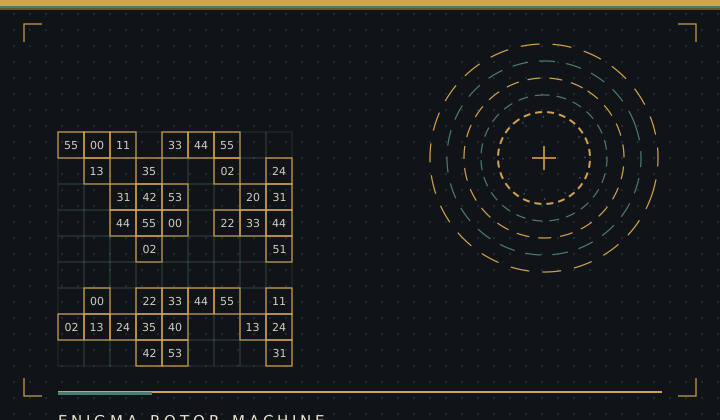
The bench beside this entry reproduces the mechanics: rotors I, II and III, reflector B, ring settings at A, no plugboard. Type a letter and watch a different letter come out; type the same letter twice and get two different outputs, because the rotors have moved in between.
| Component | Choice | Contribution to key space |
|---|---|---|
| rotor order | 3 of 5 rotors arranged | 60 |
| ring settings | 26^3 | 17,576 |
| starting positions | 26^3 | 17,576 |
| plugboard | 10 cables over 26 letters | 150,738,274,937,250 |
Two properties matter more than the arithmetic. First, Enigma is reciprocal: the same settings that encipher also decipher, so no separate decryption mode was needed — and that symmetry is exactly what made it breakable. Second, the reflector guarantees no letter ever maps to itself, which reduces the effective key space enormously for an attacker with a guessed phrase.
IIKey space
The daily key was distributed in a codebook with three parts: rotor order and ring settings for the day, a starting position for each message, and a plugboard wiring that changed every few months.
Multiplying the table above gives roughly 1.59 x 10^23. By any 1930s standard that is beyond mechanical search, and the Germans reasoned accordingly: rotor orders and plugboards were changed under a schedule they believed was unguessable.
The break did not come from reducing the space. It came from finding a property that told the attacker when a guess was wrong.
That property was the no-self-encipherment rule. Guess a fragment of plaintext at a known position — a weather report opening with WETTERVORHERSAGE, a standard salute — and you can check whether any letter would have to encrypt to itself. Almost every wrong placement fails that check instantly, and that is precisely the test Alan Turing's Bombe automated.
IIIEnciphering
- Set the rotors in the order given by the daily key — for this bench, I, II, III from left to right.
- Set the ring settings and the rotor start positions from the key sheet.
- Plug the plugboard cables as the key sheet directs; this bench runs with an empty board so the mechanics stay visible.
- For each plaintext letter: the right rotor steps first. If the right rotor is at its notch letter, the middle rotor also steps, and if the middle is at its notch the left rotor steps too.
- Send the letter through the right, middle and left rotors in that order.
- Pass the result through the reflector.
- Send it back through the left, middle and right rotors.
- The lamp that lights is the ciphertext letter. Write it down and move to the next plaintext letter.
IVDeciphering
- Set up the machine exactly as the sender's daily key sheet directs.
- Set the rotor start positions to the message key that accompanies the message.
- Type the ciphertext letters one at a time. The rotors step exactly as they did during enciphering.
- Read the plaintext off the lamps. No separate decryption mode exists because Enigma is reciprocal.
- In practice, the hard part was never this step — it was recovering the daily key. Rotor order and ring settings came from crib-based Bombe runs; the plugboard was resolved afterwards by hand.
- Reproduce the whole procedure at a fixed key to check your understanding: enciphering a message and then enciphering the result with identical settings returns you to the start.
VWeakness
No letter encrypts to itself. The single most valuable property an attacker could ask for, and it was structural, not accidental.
The reflector made it reciprocal, which made cribs work. Because enciphering and deciphering are the same operation, a guessed plaintext can be run through the machine as if it were the ciphertext, and the result compared against the intercepted message.
Operator procedure was the real leak. Cribs came from predictable message content — weather reports, standard openings, a clerk's habit of sending the same test message at the same hour. Enigma was not beaten by mathematics alone; it was beaten by mathematics plus observation of human routine.
Reflector and plugboard had their own signatures. The reflector wiring was recovered through the Polish Zyklometer and the later British Banburismus, and the plugboard could be peeled off once the rotor settings were known.
A single rotor flaw compounded. Rotor stepping meant certain start positions were far more likely than others, and the Poles exploited a duplicated key setting in early procedure to reduce the problem to a manageable search.
VIPractice
Ciphertext
PINOV NX
Hint: Rotors I II III, ring and start positions all at A, no plugboard. Remember the right rotor steps before the first letter.
Reveal the answer
Plaintext
LOOMKEY
·History note
Arthur Scherbius patented the rotor machine in 1918 and marketed it commercially before the German military adopted it. The Polish Cipher Bureau broke it first: Marian Rejewski, working with Jerzy Rozycki and Henryk Zygalski, reconstructed the internal wiring mathematically in 1932 and built the Zyklometer to exploit it. In July 1939 the Poles handed their methods and rebuilt machines to Britain and France. At Bletchley Park, Alan Turing and Gordon Welchman designed the Bombe, and by 1943 Hut 8 was reading German naval traffic within hours. Historians generally hold that the resulting intelligence, code-named Ultra, shortened the war in Europe by an estimated two years.
·Further reading
Enigma's lesson is not that big numbers are useless. Its lesson is that a cipher's real strength is the smallest amount of information an attacker needs, and that a deterministic, discoverable property can be worth more than twenty-three orders of magnitude of keyspace.
The Bombe was not a general-purpose computer and did not try to be. It was a special-purpose machine that tested one property extremely fast. The same philosophy produced Bletchley's Colossus against the Lorenz cipher, and the same philosophy runs the modern dedicated cryptanalytic appliance.
Next on the loom: Bifid Cipher — a hand cipher that gets some of the rotor's diffusion properties out of a pencil and a grid.